
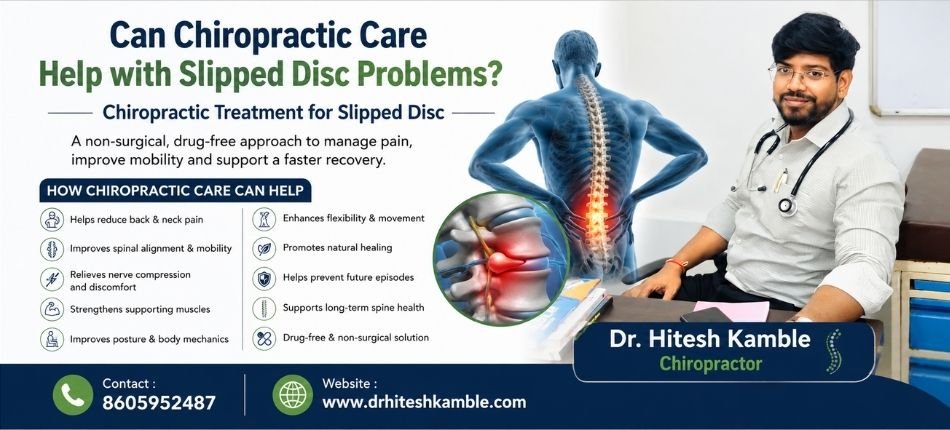
Can Chiropractic Care Help with Slipped Disc Problems? | Chiropractic Treatment for Slipped Disc – Dr. Hitesh Kamble
A slipped disc can cause significant discomfort and affect everyday activities such as sitting, walking, bending, lifting, and even sleeping. Depending on the location and severity of the disc problem, a person may experience back or neck pain, stiffness, tingling, numbness, or pain that travels into an arm or leg.
People looking for non-surgical approaches often ask whether chiropractic care can help. Chiropractic Treatment for Slipped Disc may be considered for selected patients after a proper clinical assessment. The treatment approach depends on the type of disc problem, symptoms, neurological findings, overall health, and whether there are any warning signs requiring medical or surgical evaluation.
Dr. Hitesh Kamble focuses on evaluating the underlying cause of musculoskeletal symptoms before recommending an appropriate treatment plan.
What Is a Slipped Disc?
The spine consists of individual bones called vertebrae, with intervertebral discs positioned between them. These discs act as cushions and help the spine move while absorbing mechanical stress.
A disc has a tougher outer layer surrounding a softer inner portion. When disc material bulges or herniates, it may irritate or compress nearby nerve structures. Although the term “slipped disc” is commonly used, the disc does not literally slip out of position.
Disc problems most frequently affect the lower back and neck.
What Are the Common Symptoms of a Slipped Disc?
Symptoms can vary considerably depending on the location of the affected disc and whether nearby nerves are involved. Some disc abnormalities cause no symptoms at all.
When symptoms are present, they may include lower back or neck pain, stiffness, muscle tightness, pain radiating into the buttocks or legs, pain travelling into the shoulder or arm, tingling, numbness, or weakness.
A herniated disc in the lower back may irritate the sciatic nerve and contribute to symptoms commonly referred to as sciatica.
What Causes Slipped Disc Problems?
Disc problems can develop gradually as the discs undergo age-related changes. Over time, discs may lose some of their flexibility and become more vulnerable to injury.
Other contributing factors can include improper lifting technique, repetitive strain, sudden twisting movements, physically demanding work, prolonged poor posture, and certain injuries.
In many cases, there is not one single identifiable cause.
Can Chiropractic Care Help with a Slipped Disc?
Chiropractic care may help some people manage musculoskeletal pain associated with certain disc problems, but suitability depends on the individual condition.
Before beginning treatment, the chiropractor should assess symptoms, spinal movement, medical history, neurological findings, and any available diagnostic reports. This evaluation helps determine whether conservative treatment is appropriate or whether referral for further medical investigation is needed.
The objective of Chiropractic Treatment for Slipped Disc is generally to improve movement and function and help manage pain rather than claim to physically “push” a disc back into place.
How Does Chiropractic Treatment for Slipped Disc Work?
Chiropractic treatment plans are individualized. Depending on the patient’s condition, treatment may involve carefully selected manual techniques, mobilization, therapeutic exercises, posture advice, and movement recommendations.
Treatment intensity and technique should be adapted to the patient’s symptoms rather than applying the same adjustment to every slipped disc case.
The overall goal is to improve comfortable movement, support function, and help the patient gradually return to normal activities.
Does Chiropractic Treatment Put the Disc Back in Place?
This is a common misconception.
A chiropractor does not simply push a herniated disc back into its original position. Disc-related problems are more complex and involve changes in disc structure, inflammation, mechanical sensitivity, and sometimes nerve irritation.
Treatment therefore focuses on managing symptoms and improving movement and function where conservative care is appropriate.
Chiropractic Care for Sciatica Caused by Disc Problems
A lumbar disc herniation can sometimes irritate a nerve root and cause pain that travels from the lower back or buttock into the leg. This pattern is commonly associated with sciatica.
Some people may also experience tingling, numbness, or weakness.
Because sciatica has multiple possible causes, proper assessment is important before treatment. Chiropractic or other conservative care may be considered in appropriate cases, while progressive neurological symptoms require medical evaluation.
Benefits of a Conservative Treatment Approach
A conservative treatment approach for slipped disc problems focuses on managing pain, improving movement, restoring function, and helping patients return to their normal activities without immediately considering surgery. Depending on the individual condition, treatment may include chiropractic care, therapeutic exercises, posture and ergonomic guidance, activity modification, and other non-surgical measures. For appropriately selected patients, this approach may help reduce pain and stiffness, improve spinal mobility, strengthen supporting muscles, improve movement patterns, and gradually restore confidence in everyday activities. Conservative care is usually tailored to the severity of symptoms and the patient’s response to treatment, with progress monitored over time. However, patients with significant or worsening neurological symptoms, such as progressive weakness or bladder or bowel problems, require prompt medical evaluation rather than relying solely on conservative treatment.
Role of Exercise in Slipped Disc Recovery
Exercise can be an important component of rehabilitation. Rather than depending entirely on passive treatment, patients may be given exercises designed to improve mobility, strength, endurance, and movement control.
The appropriate exercises depend on the location and severity of symptoms. An exercise that helps one person may aggravate another, which is why individualized recommendations are preferable.
As symptoms improve, rehabilitation can gradually progress toward normal daily activities.
Why Posture and Movement Habits Matter
There is no single “perfect posture” that prevents every disc problem. However, remaining in one uncomfortable position for prolonged periods can aggravate symptoms in some people.
People who work at desks may benefit from changing positions regularly, taking movement breaks, arranging their workstation comfortably, and avoiding prolonged inactivity.
Those involved in physical work can benefit from learning appropriate lifting and movement strategies.
Is Bed Rest Recommended for a Slipped Disc?
Extended bed rest is generally not the preferred approach for uncomplicated back pain.
Although a short period of reduced activity may occasionally be necessary during severe pain, remaining inactive for prolonged periods can contribute to stiffness and loss of strength.
Where medically appropriate, gradual movement and activity are usually incorporated into recovery.
When Should Chiropractic Treatment Be Avoided?
Not every person with back pain or suspected disc herniation is suitable for chiropractic treatment.
Urgent medical evaluation is particularly important if symptoms include new bladder or bowel problems, numbness around the groin or saddle area, rapidly progressing weakness, major trauma, fever with severe back pain, or other significant neurological symptoms.
These warning signs should not be managed solely with routine chiropractic care.
Do All Slipped Disc Patients Need Surgery?
No. Many people with disc-related symptoms are initially managed conservatively when there are no urgent neurological concerns.
Surgery may be considered in particular circumstances, such as significant or progressive neurological deficits or persistent severe symptoms that do not respond adequately to appropriate conservative treatment.
The decision should be made after medical evaluation and consideration of the patient’s individual circumstances.
How Long Does Recovery Take?
There is no universal recovery period for a slipped disc. Some patients improve within several weeks, while others may require a longer rehabilitation period.
Recovery can depend on the severity and location of the problem, nerve involvement, general health, physical activity, occupation, adherence to rehabilitation, and other factors.
Treatment progress should therefore be evaluated individually rather than promising a fixed number of sessions.
Chiropractic Treatment for Slipped Disc – Consult Dr. Hitesh Kamble
Slipped disc symptoms can interfere with work, sleep, exercise, and everyday movement, but surgery is not automatically required in every case.
For suitable patients, Chiropractic Treatment for Slipped Disc may form part of a conservative management plan focused on improving movement, function, and symptom control.
If you are experiencing persistent back or neck pain, radiating pain, tingling, or numbness, consult Dr. Hitesh Kamble for an appropriate assessment. Understanding the cause of your symptoms is the first step toward choosing the right treatment approach.
Chiropractic Treatment for Slipped Disc Chiropractic Treatment for Slipped Disc Chiropractic Treatment for Slipped Disc Chiropractic Treatment for Slipped Disc Chiropractic Treatment for Slipped Disc Chiropractic Treatment for Slipped Disc Chiropractic Treatment for Slipped Disc Chiropractic Treatment for Slipped Disc
