
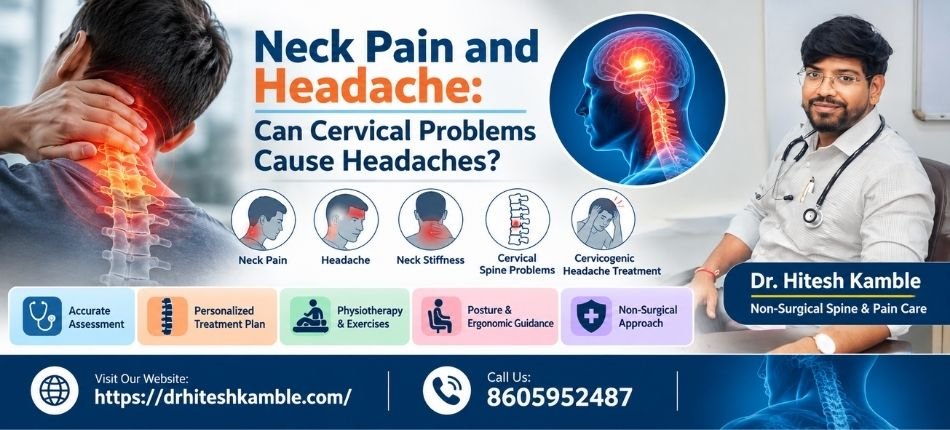
Neck Pain and Headache: Can Cervical Problems Cause Headaches? – Dr. Hitesh Kamble
Headaches are among the most common health complaints, often associated with stress, poor sleep, dehydration, or prolonged screen time. However, not every headache originates from the head itself. In some cases, the actual source of discomfort may be the cervical spine, which consists of the seven vertebrae located in the neck.
When problems affecting the neck joints, muscles, or surrounding structures trigger pain that is felt in the head, the condition may be known as a cervicogenic headache. This type of headache can affect daily activities, concentration, sleep quality, and overall comfort.
Understanding the connection between neck pain and headaches is essential for identifying the underlying cause and selecting appropriate treatment.
For individuals experiencing persistent neck discomfort and recurring headaches, Cervicogenic Headache Treatment may involve a combination of medical evaluation, targeted exercises, physiotherapy, and other conservative management approaches.
At Dr. Hitesh Kamble, patients can explore information about non-surgical spine care and treatment options for neck-related musculoskeletal concerns.
This article explains how cervical problems may contribute to headaches, their common symptoms, potential causes, diagnosis, treatment approaches, and preventive measures.
1. What Is a Cervicogenic Headache?
A cervicogenic headache is a secondary headache caused by an underlying disorder or dysfunction involving structures in the cervical spine.
Unlike primary headaches, such as migraines and tension-type headaches, cervicogenic headaches originate from a problem outside the head.
The cervical spine contains vertebrae, intervertebral discs, facet joints, muscles, ligaments, and nerves that support head movement and stability.
Pain signals from certain upper cervical structures can converge with sensory pathways that also carry pain from the head. This neurological connection helps explain why neck-related pain may be experienced in the forehead, temple, or around the eyes.
A cervicogenic headache may begin in the neck or back of the head and spread toward one side of the head.
However, the presence of neck pain alone does not confirm a cervicogenic headache. Migraines and other headache disorders can also cause neck discomfort.
An accurate diagnosis is important before beginning Cervicogenic Headache Treatment.
2. Can Cervical Spine Problems Really Cause Headaches?
Yes. Certain disorders affecting the cervical spine can cause headaches, particularly when pain-sensitive structures in the upper neck are involved.
The upper cervical nerves communicate with pathways associated with sensation in the head and face.
When joints, muscles, or other structures in this region become painful or dysfunctional, discomfort may be referred to different areas of the head.
For example, some individuals experience headaches after prolonged neck positioning, while others notice that specific neck movements reproduce their familiar headache symptoms.
Potential contributing factors include cervical joint dysfunction, neck injuries, degenerative changes, and certain musculoskeletal conditions.
Nevertheless, cervical abnormalities visible on an X-ray or MRI do not automatically establish that the neck is responsible for a headache. Clinical findings and the overall symptom pattern must also be considered.
3. Common Symptoms of Cervicogenic Headache
Cervicogenic headaches may produce several recognizable symptoms.
Headache Starting From the Neck
Pain may begin near the upper neck or base of the skull and spread toward the forehead, temple, or eye region.
One-Sided Head Pain
Cervicogenic headaches frequently affect one side of the head, although headache patterns can vary.
Neck Stiffness and Reduced Mobility
Some patients experience difficulty turning their heads or moving the neck comfortably.
Headache Triggered by Neck Movement
Specific neck movements or sustained positions may reproduce or worsen headache symptoms.
Pain Around the Shoulder Region
Discomfort may extend into the upper shoulders or surrounding neck muscles.
Tenderness in the Upper Neck
Certain areas around the upper cervical joints or muscles may feel sensitive during examination.
Difficulty With Daily Activities
Persistent pain can interfere with desk work, driving, reading, sleep, and concentration.
These symptoms can overlap with other headache conditions, so a professional assessment is necessary.
4. Common Cervical Problems That May Contribute to Headaches
Several conditions involving the cervical spine may contribute to neck-related headaches.
Cervical Joint Dysfunction
The small joints connecting cervical vertebrae help control neck movement.
When these joints become painful or their movement is restricted, some individuals may develop referred pain affecting the head.
Cervical Spondylosis
Cervical spondylosis refers to age-related degenerative changes in the cervical spine.
These changes are common and frequently occur without symptoms.
In some patients, painful cervical structures associated with degeneration may contribute to neck discomfort or headaches. However, spondylosis alone does not prove that a headache is cervicogenic.
Neck Muscle Dysfunction
Muscle tightness, weakness, or poor endurance can contribute to neck pain and may aggravate headache symptoms.
Prolonged static positions may increase muscular discomfort in susceptible individuals.
Whiplash and Previous Neck Injuries
Sudden acceleration-deceleration injuries can affect cervical muscles, ligaments, and joints.
Some individuals develop persistent neck pain and headaches following these injuries.
Cervical Disc Problems
Cervical disc degeneration or herniation can cause neck pain and, in some cases, nerve-related symptoms.
However, a disc bulge on imaging is not necessarily the cause of a headache. The relationship requires careful clinical evaluation.
5. Cervicogenic Headache vs Migraine vs Tension Headache
Understanding the differences between headache types can help patients recognize when professional assessment may be appropriate.
| Feature | Cervicogenic Headache | Migraine | Tension-Type Headache |
|---|---|---|---|
| Typical pain pattern | Often one-sided, linked to neck structures | Often one-sided, sometimes bilateral | Commonly bilateral |
| Neck discomfort | Frequently present | May also occur | May also occur |
| Neck movement | May reproduce familiar headache | Not typically the defining trigger | Not typically the defining trigger |
| Nausea | Less characteristic | Common in some attacks | Usually absent |
| Light sensitivity | Possible, usually less prominent | Common | Sometimes mild |
| Neck mobility | May be restricted | Often normal between attacks | Usually not significantly restricted |
These patterns are not definitive diagnostic rules.
Some patients experience more than one headache disorder, and migraine can be accompanied by significant neck pain.
6. How Is a Cervicogenic Headache Diagnosed?
Diagnosing a cervicogenic headache requires a detailed medical evaluation to determine whether the headache originates from the cervical spine or another underlying condition. A healthcare professional typically begins by reviewing the patient’s medical history, headache frequency, pain location, severity, and associated symptoms. Particular attention is given to whether the headache starts at the back of the neck, spreads toward the forehead or temples, or becomes worse during specific neck movements. A physical examination may include checking cervical spine mobility, muscle tenderness, neck stiffness, and neurological function. In some cases, imaging tests such as X-rays, MRI scans, or CT scans may be recommended to investigate suspected structural abnormalities, although imaging findings alone cannot confirm a cervicogenic headache. When necessary, specialists may use diagnostic nerve blocks to help identify the source of pain. Since symptoms can overlap with migraines and tension-type headaches, an accurate diagnosis is essential before starting Cervicogenic Headache Treatment. Early evaluation can help identify the underlying cause and guide appropriate non-surgical treatment options, including physiotherapy, targeted exercises, and individualized pain management.
7. Cervicogenic Headache Treatment: Non-Surgical Options
Cervicogenic Headache Treatment generally focuses on addressing the underlying cervical problem, improving neck function, and reducing headache-related discomfort.
Treatment varies according to the diagnosis, severity, medical history, and individual response.
A. Physiotherapy and Targeted Exercises
Physiotherapy is commonly used as part of conservative management for cervicogenic headaches.
A structured program may include exercises designed to improve cervical mobility, strengthen neck and shoulder muscles, and enhance muscular endurance.
Deep neck flexor exercises and shoulder blade strengthening may be appropriate for selected patients.
Exercise selection should be based on an individual assessment rather than a standard routine for every patient.
B. Cervical Mobilization and Manual Therapy
Some patients may benefit from carefully selected manual therapy techniques performed by appropriately trained healthcare professionals.
These techniques may help improve movement and reduce discomfort when used alongside exercise and education.
However, manual treatment is not suitable for every patient.
High-velocity neck manipulation carries potential risks, including rare but serious vascular complications. It should not be performed without appropriate screening, informed consent, and consideration of safer alternatives.
C. Posture and Ergonomic Guidance
Prolonged desk work, poorly positioned screens, and sustained neck postures may aggravate musculoskeletal symptoms.
Ergonomic adjustments can help reduce unnecessary strain.
Useful changes may include positioning the computer screen comfortably, supporting the lower back, keeping frequently used items within reach, and taking regular movement breaks.
There is no single perfect posture that prevents headaches. Regular movement and comfortable positioning are generally more useful than maintaining a rigid posture.
D. Pain Management
Depending on the diagnosis, a medical professional may recommend appropriate pain-relieving medication or other treatments.
Medication choice depends on individual health conditions, potential side effects, and other medicines being taken.
Frequent use of certain headache medications can also contribute to medication-overuse headaches, making medical guidance important.
E. Heat Therapy
Some individuals find that gentle heat helps relieve associated neck muscle discomfort.
Heat should be applied safely, avoiding excessive temperature and prolonged direct skin exposure.
Heat therapy may provide temporary symptom relief but does not address every possible cause of headache.
F. Specialist Treatment for Persistent Cases
When headaches remain severe or persistent despite appropriate conservative care, referral to a neurologist, pain specialist, or spine specialist may be necessary.
In selected patients with a confirmed cervical pain source, specialist procedures such as diagnostic nerve blocks or other interventions may be considered.
The suitability of these treatments depends on the specific diagnosis and clinical findings.
8. Can Poor Posture and Mobile Phone Use Cause Cervicogenic Headaches?
Prolonged mobile phone use and desk work may contribute to neck discomfort, particularly when a person maintains the same position for extended periods.
Looking downward at a phone or working with an uncomfortable computer setup can increase muscular fatigue and aggravate existing neck symptoms.
For some individuals, this discomfort may occur alongside headaches.
However, mobile phone use or poor posture alone does not establish a diagnosis of cervicogenic headache.
The relationship between posture and headache disorders is complex, and multiple factors may contribute to symptoms.
Practical strategies include taking regular movement breaks, adjusting screen height, avoiding prolonged static positions, and performing appropriate strengthening exercises.
People with frequent headaches should seek assessment rather than assuming that posture is the only cause.
9. Exercises That May Help With Neck-Related Headaches
A healthcare professional may recommend gentle exercises after evaluating the cause of neck pain and headaches.
Chin Tuck Exercises
Chin tucks involve gently drawing the chin backward while keeping the head level.
This movement may help improve awareness and control of the cervical muscles.
Gentle Neck Rotation
Slowly turning the head within a comfortable range may help maintain cervical mobility.
Movements should not be forced through pain.
Shoulder Blade Retraction
Gently drawing the shoulder blades backward can activate muscles involved in supporting the upper back and shoulders.
Upper Back Mobility Exercises
Selected thoracic mobility exercises may help individuals who experience discomfort during prolonged sitting.
Neck Strengthening
Progressive strengthening exercises may improve neck muscle endurance and function.
Important: Exercises should not reproduce severe headache, dizziness, visual symptoms, numbness, or neurological discomfort. Stop the activity and seek medical advice if concerning symptoms develop.
10. When Should You See a Doctor for Neck Pain and Headaches?
Occasional mild headaches accompanied by neck discomfort may improve with rest, gentle movement, and appropriate self-care. However, if you experience frequent headaches, persistent neck stiffness, restricted neck movement, or pain that interferes with work, sleep, and daily activities, it is important to consult a qualified healthcare professional. Headaches that repeatedly begin at the base of the skull, worsen when turning the head, or occur after prolonged sitting or computer use may suggest a possible connection with cervical spine problems, although these symptoms are not specific to cervicogenic headaches. Individuals experiencing recurring headaches despite initial treatment should seek medical evaluation to rule out migraines, tension-type headaches, and other potential causes. Immediate emergency medical attention is necessary if a headache develops suddenly and is extremely severe, or occurs with weakness, difficulty speaking, vision loss, confusion, fever with marked neck stiffness, or significant neurological symptoms. Severe headache or neck pain following an injury also requires prompt assessment. For patients experiencing ongoing neck-related discomfort, appropriate Cervicogenic Headache Treatment may help improve cervical mobility, manage pain, and support daily functioning once the underlying cause has been identified.
11. How to Prevent Neck Pain and Recurrent Headaches
Although not every cervicogenic headache can be prevented, healthy movement habits and appropriate musculoskeletal care may reduce some contributing factors.
Take Regular Breaks: Avoid remaining in one position for prolonged periods. Short movement breaks can help reduce muscle fatigue.
Maintain Comfortable Workstation Ergonomics: Adjust your chair, screen, and keyboard to reduce unnecessary strain during work.
Stay Physically Active: Regular physical activity and suitable strengthening exercises support general musculoskeletal health.
Manage Stress: Stress may contribute to muscle tension and coexist with different headache disorders.
Prioritize Sleep: Consistent sleep habits can support overall health and headache management.
Avoid Aggressive Neck Movements: Forceful stretching, self-manipulation, and sudden neck movements may aggravate symptoms or cause injury.
Seek Early Assessment: Persistent or changing headaches deserve professional evaluation rather than repeated self-treatment.
12. Why Consult Dr. Hitesh Kamble for Neck-Related Pain in Ambernath?
Persistent neck pain and recurring headaches can affect comfort, mobility, concentration, and daily productivity.
Dr. Hitesh Kamble provides information about non-surgical approaches to neck and spine-related musculoskeletal concerns in Ambernath.
Patients experiencing neck discomfort can explore available services and discuss whether conservative management may be appropriate for their condition.
A proper assessment is important because headaches can arise from several different causes, and not all headaches associated with neck pain are cervicogenic.
For more information about cervical spine care, visit the Chiropractic Care in Ambernath service page.
Treatment decisions should be based on an appropriate diagnosis, individual medical history, and clinical findings.
Conclusion
Neck pain and headaches are sometimes connected, particularly when disorders affecting the upper cervical spine contribute to referred pain in the head.
Cervicogenic headaches may be associated with neck stiffness, reduced cervical movement, and headaches triggered by certain neck positions or movements.
However, neck pain can also accompany migraine and other headache disorders, making accurate diagnosis essential.
Cervicogenic Headache Treatment may include targeted physiotherapy, strengthening exercises, ergonomic guidance, appropriate pain management, and specialist care when necessary.
For individuals experiencing persistent neck discomfort and recurring headaches in Ambernath, consulting a qualified healthcare professional can help identify the underlying problem and determine suitable treatment options.
Learn more about neck and spine care with Dr. Hitesh Kamble.
Website: www.drhiteshkamble.com
Cervicogenic Headache Treatment Cervicogenic Headache Treatment Cervicogenic Headache Treatment Cervicogenic Headache Treatment Cervicogenic Headache Treatment Cervicogenic Headache Treatment Cervicogenic Headache Treatment Cervicogenic Headache Treatment Cervicogenic Headache Treatment Cervicogenic Headache Treatment Cervicogenic Headache Treatment Cervicogenic Headache Treatment Cervicogenic Headache Treatment Cervicogenic Headache Treatment Cervicogenic Headache Treatment Cervicogenic Headache Treatment Cervicogenic Headache Treatment Cervicogenic Headache Treatment Cervicogenic Headache Treatment Cervicogenic Headache Treatment
