
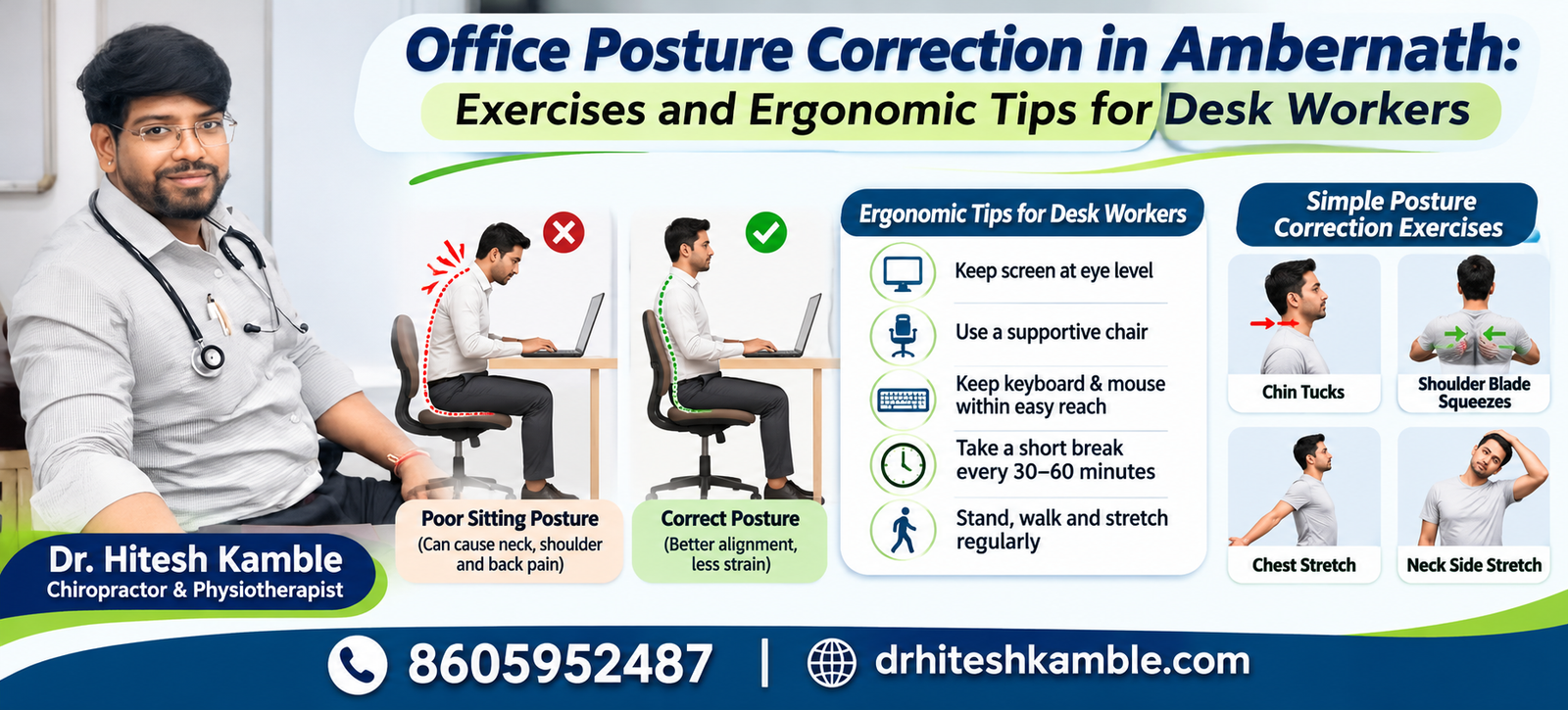
Office Posture Correction in Ambernath: Exercises and Ergonomic Tips for Desk Workers – Dr. Hitesh Kamble
Spending long hours at a desk can contribute to neck pain, shoulder stiffness, and back discomfort. Office Posture Correction in Ambernath focuses on improving workplace ergonomics, strengthening supporting muscles, and developing healthier sitting habits.
At Dr. Hitesh Kamble’s Chiropractic Care in Ambernath, office workers can seek professional guidance for posture-related discomfort, spinal mobility, and musculoskeletal health.
In this article, we explain common posture problems among office workers, their causes, practical correction exercises, ergonomic adjustments, and when to seek professional help.
1. Why Is Posture Correction Important for Office Workers?
Office employees often spend six to nine hours or more sitting at desks. Remaining in the same position for extended periods can contribute to muscle fatigue, stiffness, and discomfort.
Posture correction for office workers focuses on improving body alignment, encouraging regular movement, and reducing unnecessary strain on muscles and joints.
Maintaining comfortable posture and changing positions regularly may help:
- Reduce neck and shoulder discomfort
- Minimize lower back stiffness
- Improve spinal mobility and flexibility
- Reduce muscle fatigue during desk work
- Improve workstation comfort
- Support long-term musculoskeletal health
It is important to understand that there is no single perfect sitting posture. Regular movement and comfortable positioning are often more beneficial than maintaining one rigid position throughout the day.
2. Common Posture Problems Among Office Workers
Forward Head Posture
Forward head posture occurs when the head is positioned in front of the shoulders, commonly while looking at computer screens or smartphones.
This position may contribute to neck muscle fatigue, stiffness, and discomfort, particularly when maintained for long periods.
Common symptoms include:
- Neck stiffness
- Shoulder discomfort
- Upper back tightness
- Tension-type headaches
- Reduced neck mobility
Rounded Shoulders
Rounded shoulders occur when the shoulders remain positioned forward for prolonged periods.
This posture may be associated with tight chest muscles, reduced upper back mobility, and muscle fatigue.
Slouched Sitting Posture
Slouching for long periods may increase discomfort in the lower back and surrounding muscles.
Workers who sit without adequate back support or rarely change positions may experience increased stiffness.
Upper Crossed Syndrome
Upper Crossed Syndrome describes a commonly discussed pattern of muscle imbalance involving the neck, shoulders, chest, and upper back.
It is often associated with forward head posture and rounded shoulders.
However, posture alone does not establish this diagnosis. A professional assessment helps identify the factors contributing to discomfort.
Lower Back Discomfort
Prolonged sitting, limited movement, unsuitable workstation arrangements, and individual health factors may contribute to lower back discomfort.
3. What Causes Poor Posture in Office Workers?
Several workplace and lifestyle factors may contribute to posture-related problems.
Prolonged Sitting
Remaining seated for extended periods without movement breaks can increase muscle fatigue and stiffness.
Incorrect Monitor Position
A screen positioned too low or too far away may encourage excessive neck bending or forward leaning.
Poor Chair Support
A chair that does not comfortably support the lower back or allow the feet to rest securely may contribute to discomfort.
Excessive Smartphone Usage
Looking down at mobile devices for prolonged periods can place sustained demands on neck muscles.
Limited Physical Activity
Insufficient movement and physical activity may contribute to reduced muscular endurance, flexibility, and general conditioning.
Work-Related Stress
Stress can increase muscle tension and may contribute to neck and shoulder discomfort.
4. Early Signs That You May Need Posture Correction
Office workers should pay attention to recurring discomfort, particularly when symptoms increase during working hours.
Common warning signs include:
- Frequent neck pain after computer work
- Shoulder stiffness or tightness
- Upper back discomfort
- Lower back pain after prolonged sitting
- Difficulty sitting comfortably for extended periods
- Reduced neck or shoulder mobility
- Muscle fatigue during desk work
- Recurring headaches associated with neck tension
These symptoms can have multiple causes and should not automatically be attributed to poor posture.
If symptoms persist, worsen, or interfere with daily activities, seek professional assessment.
5. Best Posture Correction Exercises for Office Workers
Simple exercises may help improve mobility, muscle endurance, and comfort during office work.
Perform movements slowly and within a comfortable range. Stop if an exercise causes increasing pain, dizziness, or neurological symptoms.
Exercise 1: Chin Tucks
Purpose: Encourage gentle neck movement and improve awareness of head positioning.
How to perform:
- Sit or stand comfortably.
- Keep your eyes facing forward.
- Gently move your chin backward without tilting your head.
- Hold for approximately 3–5 seconds.
- Relax and repeat 8–10 times.
Avoid forcing the movement.
Exercise 2: Shoulder Blade Squeezes
Purpose: Activate muscles around the shoulder blades.
Steps:
- Sit upright in a comfortable position.
- Gently draw your shoulder blades toward each other.
- Hold for 3–5 seconds.
- Relax slowly.
- Repeat 10 times.
Avoid excessive arching of the lower back.
Exercise 3: Chest Stretch
Purpose: Improve flexibility around the chest and front shoulders.
Steps:
- Stand beside a doorway.
- Place your forearm against the doorframe.
- Gently turn your body away until you feel a comfortable stretch.
- Hold for 15–20 seconds.
- Repeat on both sides.
Avoid stretching into pain.
Exercise 4: Seated Thoracic Extension
Purpose: Encourage movement in the upper back.
Steps:
- Sit on a stable chair with a supportive backrest.
- Place your hands behind your head.
- Gently extend your upper back over the chair’s backrest.
- Return to the starting position.
- Repeat 8–10 times.
Exercise 5: Neck Side Stretch
Purpose: Gently stretch muscles along the side of the neck.
Steps:
- Sit comfortably.
- Slowly tilt your head toward one shoulder.
- Hold for 15–20 seconds.
- Return to the center.
- Repeat on the opposite side.
Avoid pulling your head forcefully.
Exercise 6: Standing Back Extension
Purpose: Introduce movement after prolonged sitting.
Steps:
- Stand comfortably with your feet shoulder-width apart.
- Place your hands on your hips.
- Gently lean backward within a comfortable range.
- Return to an upright position.
- Repeat 5–10 times.
Exercise selection should be individualized, particularly for people with existing spinal conditions or persistent pain.
6. Ergonomic Tips for Better Posture at Work
Improving workstation ergonomics can make desk work more comfortable and reduce unnecessary physical strain.
Adjust Your Chair Height
Choose a height that allows your feet to rest flat on the floor or on a footrest.
Keep your thighs comfortably supported.
Position Your Computer Monitor Correctly
Place the monitor approximately an arm’s length away, adjusting the distance for comfortable viewing.
The top of the screen should generally be at or slightly below eye level.
Maintain Comfortable Back Support
Use a chair that supports your lower back without forcing an unnatural spinal position.
Keep Your Keyboard and Mouse Close
Position your keyboard and mouse where your shoulders can remain relaxed and your elbows stay comfortably near your body.
Avoid Sitting Continuously
Take regular movement breaks.
Stand, walk, stretch, or change your working position throughout the day.
Use a Laptop Stand
If you work on a laptop for extended periods, consider using a laptop stand with an external keyboard and mouse.
This can help improve screen height and arm positioning.
7. How Often Should Office Workers Take Posture Breaks?
Taking regular posture breaks is essential for office workers who spend long hours sitting in front of computers. Prolonged sitting without movement can contribute to muscle stiffness, neck pain, shoulder tension, and lower back discomfort. To maintain better posture and reduce physical strain, office workers should aim to take a short movement break every 30–60 minutes. During these breaks, simple activities such as standing, walking, gently stretching the neck and shoulders, or changing sitting positions can help relieve muscle tension and improve comfort. Incorporating regular posture breaks into your daily routine, along with proper workstation ergonomics, can support spinal mobility, reduce muscle fatigue, and promote long-term musculoskeletal health.
8. How Can Chiropractic Care Help with Posture Correction in Ambernath?
People experiencing persistent neck pain, back stiffness, or posture-related discomfort may benefit from a professional musculoskeletal assessment.
At Dr. Hitesh Kamble’s clinic in Ambernath, consultation can help identify potential contributing factors and guide an individualized management approach.
Depending on clinical findings, management may include:
Postural Assessment: Evaluating comfortable movement patterns, workstation habits, and factors associated with symptoms.
Spinal Mobility Assessment: Examining neck, upper back, and lower back movement.
Exercise Guidance: Recommending appropriate strengthening, mobility, and stretching exercises.
Ergonomic Education: Providing advice about desk setup, screen positioning, sitting habits, and movement breaks.
Individualized Care: Developing a suitable management approach based on symptoms, physical findings, and individual requirements.
Manual therapy may be considered in selected cases as part of a broader treatment plan, but it is not necessary for everyone and does not permanently correct posture by itself.
9. Can Poor Posture Cause Neck Pain and Headaches?
Prolonged static positions and muscle fatigue may contribute to neck discomfort and certain headaches.
However, headaches and neck pain can arise from several causes, including migraine, tension-type headaches, cervical conditions, and other medical problems.
A proper assessment is important when symptoms are persistent or recurring.
Seek urgent medical attention for sudden severe headaches, new weakness, significant neurological symptoms, or neck pain following major trauma.
10. How Long Does Posture Correction Take?
There is no fixed timeline for improving posture-related discomfort.
Progress depends on factors such as:
- Duration and severity of symptoms
- Physical activity levels
- Muscular strength and endurance
- Workstation conditions
- Exercise consistency
- Underlying medical conditions
- Individual response to treatment
Some individuals may notice improved comfort after making ergonomic adjustments and taking regular movement breaks.
Others may require a longer period of exercise-based rehabilitation and professional guidance.
Consistency is more important than trying to achieve immediate changes.
11. Daily Posture Correction Routine for Office Workers
A simple daily routine can help encourage healthier movement habits.
| Time | Recommended Activity |
|---|---|
| Before work | 5 minutes of gentle neck and shoulder mobility |
| Every 30–60 minutes | Stand, walk, or change position |
| Mid-morning | Shoulder blade squeezes and chest stretches |
| Lunch break | 10–15 minutes of comfortable walking |
| Afternoon | Check screen height and chair position |
| After work | 15–20 minutes of walking or suitable exercise |
| Evening | Gentle stretching and relaxation |
This routine is a general example and can be adjusted according to individual needs.
12. When Should You Consult a Posture Correction Specialist in Ambernath?
If you frequently experience neck pain, shoulder stiffness, lower back discomfort, or recurring headaches after prolonged desk work, it may be time to consult a posture correction specialist. Persistent discomfort, restricted neck movement, muscle tightness, or pain that interferes with daily activities may indicate the need for professional assessment. Seeking guidance for Office Posture Correction in Ambernath can help identify contributing factors such as poor workstation ergonomics, muscle weakness, prolonged sitting, and reduced spinal mobility. Dr. Hitesh Kamble in Ambernath provides professional guidance for posture-related musculoskeletal concerns, including individualized exercise recommendations, ergonomic advice, and appropriate treatment options. Early assessment and consistent posture management can help improve comfort, mobility, and overall physical well-being.
13. Why Choose Dr. Hitesh Kamble for Posture Correction in Ambernath?
If you are searching for Posture Correction for Office Workers in Ambernath, Dr. Hitesh Kamble provides a local option for consultation regarding posture-related musculoskeletal concerns.
The focus of appropriate posture management is not simply to make the spine appear straighter. It is to improve comfortable movement, physical function, muscular endurance, and sustainable workplace habits.
An individualized approach may help office workers better understand their symptoms and adopt practical strategies for managing everyday discomfort.
Conclusion
Posture Correction in Ambernath is an important consideration for office workers experiencing recurring neck pain, shoulder stiffness, and back discomfort.
Simple changes such as improving workstation ergonomics, performing appropriate exercises, staying physically active, and taking regular movement breaks can help improve comfort and support musculoskeletal health.
If you experience persistent posture-related discomfort, consulting Dr. Hitesh Kamble in Ambernath can help you understand possible causes and explore appropriate treatment options.
Take the First Step Towards Better Posture and Comfortable Movement!
Visit: https://drhiteshkamble.com/
Office Posture Correction in Ambernath Office Posture Correction in Ambernath Office Posture Correction in Ambernath Office Posture Correction in Ambernath Office Posture Correction in Ambernath Office Posture Correction in Ambernath Office Posture Correction in Ambernath Office Posture Correction in Ambernath Office Posture Correction in Ambernath Office Posture Correction in Ambernath Office Posture Correction in Ambernath Office Posture Correction in Ambernath Office Posture Correction in Ambernath Office Posture Correction in Ambernath Office Posture Correction in Ambernath Office Posture Correction in Ambernath Office Posture Correction in Ambernath Office Posture Correction in Ambernath Office Posture Correction in Ambernath
