
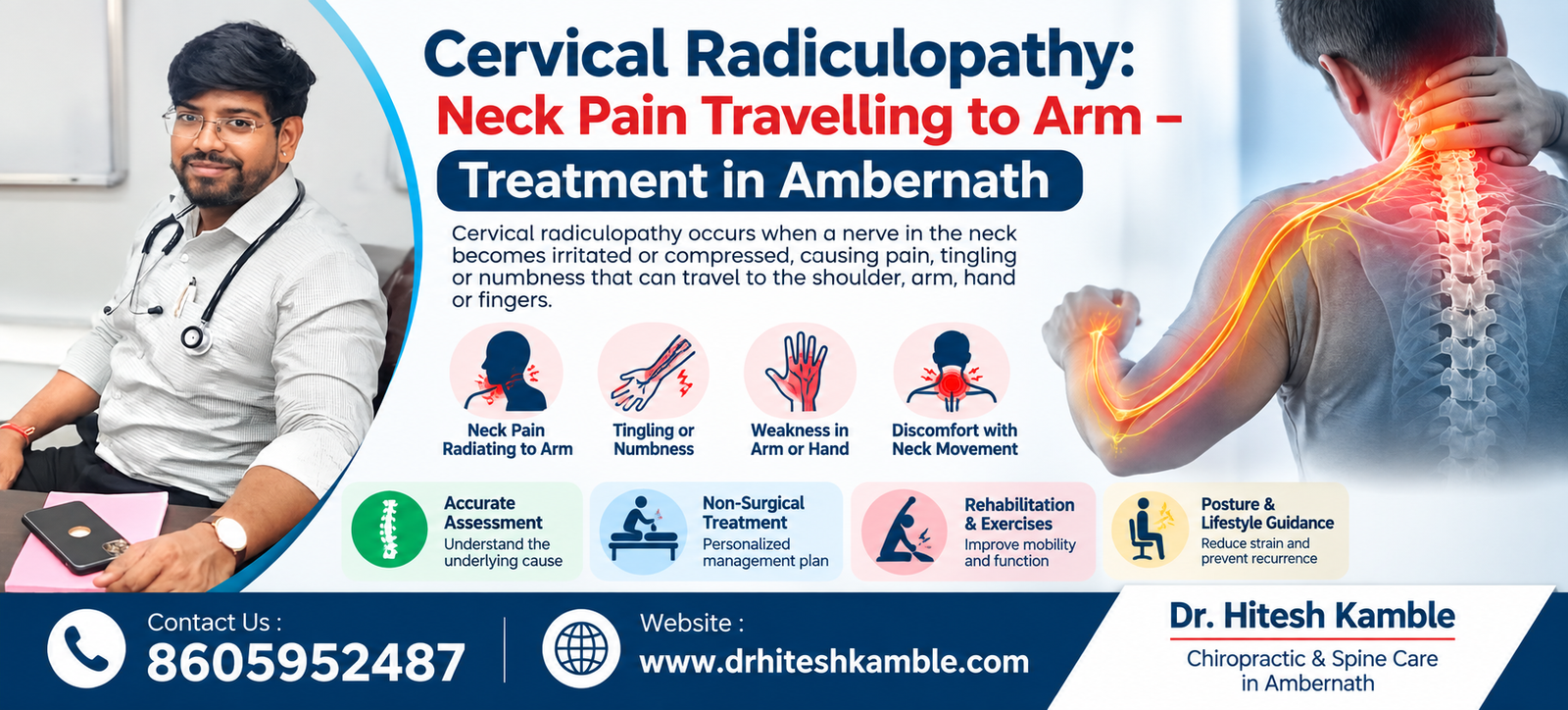
Cervical Radiculopathy: Neck Pain Travelling to Arm – Treatment in Ambernath | Dr. Hitesh Kamble
Introduction
Neck discomfort that travels into the shoulder, arm, hand, or fingers may sometimes be related to irritation or compression of a nerve in the cervical spine. This condition is known as cervical radiculopathy. Along with neck and arm pain, some people may experience tingling, numbness, altered sensation, or weakness in the affected arm or hand.
The symptoms of cervical radiculopathy can overlap with other neck, shoulder, and upper-limb conditions. Therefore, proper clinical evaluation is important before starting treatment. Patients experiencing recurring neck discomfort, restricted movement, or pain travelling into the arm can also learn more about Chiropractic Care in Ambernath and the assessment-based approach provided by Dr. Hitesh Kamble.
Cervical Radiculopathy Treatment in Ambernath depends on the underlying cause, severity of symptoms, neurological findings, and individual functional requirements. Appropriate management may include activity modification, rehabilitation, therapeutic exercises, posture guidance, and other conservative approaches depending on the diagnosis.
In this detailed guide, we explain cervical radiculopathy, its possible causes and symptoms, diagnosis, non-surgical treatment options, rehabilitation, and signs that require prompt medical attention.
What Is Cervical Radiculopathy?
Cervical radiculopathy occurs when a nerve root in the neck becomes irritated or compressed. These nerve roots originate from the cervical spinal cord and carry signals between the neck and areas of the shoulder, arm, hand, and fingers.
When a cervical nerve root is affected, symptoms may be experienced along the pathway supplied by that nerve. This is why a problem originating in the neck can sometimes produce pain, tingling, numbness, or weakness further down the arm.
The exact pattern of symptoms can vary depending on which nerve root is involved.
Why Does Neck Pain Travel to the Arm?
The nerves supplying the shoulders, arms, hands, and fingers originate partly from nerve roots in the cervical spine. If one of these nerve roots becomes irritated, symptoms can travel away from the neck and into the upper limb.
A person may therefore experience discomfort beginning around the neck or shoulder and extending into the upper arm, forearm, hand, or individual fingers. Some people describe the sensation as sharp, burning, shooting, or electric-like.
However, arm pain does not always originate from the cervical spine. Shoulder problems, peripheral nerve conditions, and other causes can produce overlapping symptoms, making appropriate assessment important.
Common Symptoms of Cervical Radiculopathy
Symptoms can vary according to the affected nerve root and severity of nerve irritation. A person may experience neck discomfort that radiates into one shoulder or arm, along with burning, shooting, or electric-like sensations. Tingling or numbness may occur in parts of the arm, hand, or fingers, and some people may notice reduced grip strength or muscle weakness. Certain neck movements may aggravate the symptoms, although the pattern can differ between individuals.
What Causes Cervical Radiculopathy?
Cervical radiculopathy can develop when changes in or around the cervical spine reduce the space available for a nerve root or directly irritate it.
Two commonly considered causes are cervical disc problems and age-related degenerative changes. However, the underlying reason should be established through clinical evaluation rather than assumed from symptoms alone.
Cervical Disc Herniation
The cervical spine contains discs between the vertebrae that help absorb mechanical forces and allow movement. When disc material protrudes or herniates, it may irritate or compress a nearby nerve root.
This can produce neck symptoms together with radiating arm pain, tingling, numbness, or weakness depending on the affected nerve.
Age-Related Degenerative Changes
Over time, changes can occur in the cervical discs, joints, and surrounding structures. These changes may sometimes reduce the space through which nerve roots exit the spine.
When a nerve root becomes compressed or irritated as a result, cervical radiculopathy symptoms can develop.
Cervical Radiculopathy vs Normal Neck Pain
Ordinary mechanical neck discomfort is often primarily felt around the neck and upper shoulder region. Cervical radiculopathy, in contrast, involves symptoms associated with a cervical nerve root.
The presence of pain travelling down the arm, tingling, numbness, altered sensation, or muscle weakness may suggest nerve involvement.
However, symptoms alone cannot confirm the diagnosis because several conditions can produce similar complaints. A physical and neurological examination helps determine whether a cervical nerve root is likely to be involved.
Cervical Radiculopathy vs Pinched Nerve
The term pinched nerve is commonly used to describe a nerve that is compressed or irritated. Cervical radiculopathy is a more specific clinical term describing symptoms arising from irritation or compression of a cervical nerve root.
Therefore, cervical radiculopathy may sometimes be described informally as a pinched nerve in the neck.
The underlying cause of that nerve irritation still needs to be identified before an appropriate treatment plan can be developed.
How Is Cervical Radiculopathy Diagnosed?
Diagnosis generally begins with a detailed history and physical examination. The clinician may ask where the discomfort begins, how far it travels, which fingers are affected, and whether the patient has experienced numbness or weakness.
The examination may assess neck movement, sensation, muscle strength, reflexes, grip function, and specific movements that reproduce or modify symptoms.
These findings help determine whether a cervical nerve root may be involved and which nerve level could potentially be affected.
Is an MRI Required for Cervical Radiculopathy?
An MRI is not necessarily required immediately for every person with neck and arm symptoms. In many situations, the initial assessment is based on medical history and clinical examination.
MRI may be considered when symptoms persist despite appropriate conservative management, neurological weakness is significant or progressing, or clinical findings suggest that further investigation is necessary.
MRI can provide detailed information about cervical discs, nerve roots, the spinal canal, and surrounding structures. Imaging findings should always be interpreted alongside the patient’s symptoms and examination.
Cervical Radiculopathy Treatment in Ambernath
Cervical Radiculopathy Treatment in Ambernath should be based on the underlying cause, severity of symptoms, duration of the problem, and neurological findings.
Many patients may initially be considered for conservative management when there are no indications for urgent specialist intervention.
Treatment can involve activity modification, rehabilitation, therapeutic exercises, posture and movement guidance, and other non-surgical approaches appropriate to the patient’s condition.
Role of Conservative Treatment
Conservative treatment aims to reduce aggravating factors, improve comfortable movement, restore function, and gradually help the patient return to normal activities.
The specific treatment approach varies between patients. What helps one person may not necessarily be appropriate for another because cervical radiculopathy can involve different nerve roots and underlying causes.
For this reason, exercises and rehabilitation programmes should ideally be selected after an appropriate assessment.
Role of Chiropractic Care
Depending on the diagnosis and individual clinical findings, conservative musculoskeletal care may be considered as part of the management plan.
Before any manual treatment is considered, the patient’s symptoms, neurological findings, medical history, and possible contraindications should be assessed carefully. Treatment techniques should be individualized rather than applying the same approach to every patient.
Patients experiencing neck and arm symptoms can learn more about Chiropractic Care in Ambernath and the assessment-based approach provided by Dr. Hitesh Kamble.
Exercises for Cervical Radiculopathy
Therapeutic exercises may form part of rehabilitation for suitable patients. Depending on the assessment, exercises may focus on cervical mobility, postural control, shoulder-blade function, muscular endurance, or other identified movement limitations.
Exercises should be performed gradually and should not be selected solely from general online recommendations.
If an exercise significantly increases radiating arm pain, numbness, weakness, dizziness, or other unusual symptoms, it should be stopped and appropriate professional advice obtained.
Posture and Cervical Radiculopathy
Long periods of sitting, repetitive neck positions, and unsuitable workstation arrangements may aggravate symptoms in some individuals.
For people who spend long hours working on computers, attention may be given to monitor height, chair positioning, keyboard placement, movement breaks, and avoiding unnecessarily prolonged static positions.
Posture is only one possible contributing factor and should not automatically be assumed to be the primary cause of cervical radiculopathy.
Cervical Radiculopathy and Mobile Phone Use
Prolonged periods looking downward at a mobile phone can place the neck in a sustained position and may aggravate existing neck symptoms in some people.
Taking regular breaks, changing positions, and avoiding holding the neck in one position for extended periods can be useful practical measures.
However, mobile phone use itself does not establish the cause of cervical radiculopathy. Persistent radiating arm symptoms still require appropriate assessment.
How Long Does Cervical Radiculopathy Take to Improve?
Recovery time varies considerably. It depends on the underlying cause, severity of nerve irritation, duration of symptoms, presence of weakness, general health, and response to treatment.
Some patients may improve with conservative management, while others may require a longer rehabilitation period or additional investigations.
Rather than relying on a fixed recovery timeline, progress should be assessed according to changes in symptoms, neurological findings, movement, and functional ability.
Activities to Modify During Recovery
During an episode of cervical radiculopathy, activities that repeatedly aggravate neck or arm symptoms may need temporary modification.
This does not necessarily mean complete inactivity. Depending on the patient’s condition, maintaining comfortable everyday movement and gradually returning to normal activities may be preferable to prolonged rest.
Specific restrictions should be based on the individual’s symptoms and professional assessment.
When Should You Seek Medical Evaluation?
Medical evaluation is advisable when neck discomfort repeatedly travels into the arm, particularly when accompanied by persistent tingling, numbness, reduced grip strength, or weakness.
Assessment is also appropriate when symptoms are progressively worsening, repeatedly returning, interfering with sleep or work, or not improving with reasonable conservative measures.
Early evaluation can help distinguish cervical radiculopathy from shoulder disorders, peripheral nerve problems, and other conditions that can produce similar symptoms.
Warning Signs That Need Prompt Medical Attention
Certain symptoms require prompt medical assessment rather than routine self-management.
Seek medical attention if neck and arm symptoms are associated with progressive muscle weakness, increasing loss of sensation, difficulty with balance or walking, loss of hand coordination, symptoms affecting both arms or legs, or bladder or bowel changes.
Severe symptoms following significant trauma also require appropriate medical evaluation.
Can Cervical Radiculopathy Be Treated Without Surgery?
Many cases may initially be managed without surgery, depending on their cause and severity. Conservative treatment may include activity modification, rehabilitation, therapeutic exercises, and medication prescribed by an appropriate medical professional when required.
Surgical or specialist assessment may be considered when significant neurological problems are present, weakness is progressing, or symptoms remain severe despite appropriate conservative treatment.
The need for surgery cannot be determined solely by the presence of arm pain or an MRI finding.
Cervical Radiculopathy Treatment in Ambernath – Dr. Hitesh Kamble
If you are experiencing neck discomfort that travels into the shoulder, arm, hand, or fingers, proper evaluation can help determine whether cervical nerve irritation is contributing to your symptoms.
Dr. Hitesh Kamble provides assessment and conservative management for patients with neck, spine, and musculoskeletal complaints in Ambernath.
A treatment plan can be developed according to the patient’s symptoms, physical examination, neurological findings, and individual functional requirements.
Conclusion
Cervical radiculopathy occurs when a cervical nerve root becomes irritated or compressed, potentially causing neck discomfort that travels into the shoulder, arm, hand, or fingers. Tingling, numbness, altered sensation, and muscle weakness may occur alongside pain.
Because several neck, shoulder, and nerve conditions can produce similar symptoms, accurate assessment is important before beginning treatment. Cervical Radiculopathy Treatment in Ambernath should be individualized according to the underlying cause, neurological findings, symptom severity, and functional requirements.
Cervical Radiculopathy Treatment in Ambernath Cervical Radiculopathy Treatment in Ambernath Cervical Radiculopathy Treatment in Ambernath Cervical Radiculopathy Treatment in Ambernath Cervical Radiculopathy Treatment in Ambernath Cervical Radiculopathy Treatment in Ambernath Cervical Radiculopathy Treatment in Ambernath Cervical Radiculopathy Treatment in Ambernath Cervical Radiculopathy Treatment in Ambernath Cervical Radiculopathy Treatment in Ambernath Cervical Radiculopathy Treatment in Ambernath Cervical Radiculopathy Treatment in Ambernath Cervical Radiculopathy Treatment in Ambernath Cervical Radiculopathy Treatment in Ambernath Cervical Radiculopathy Treatment in Ambernath
