
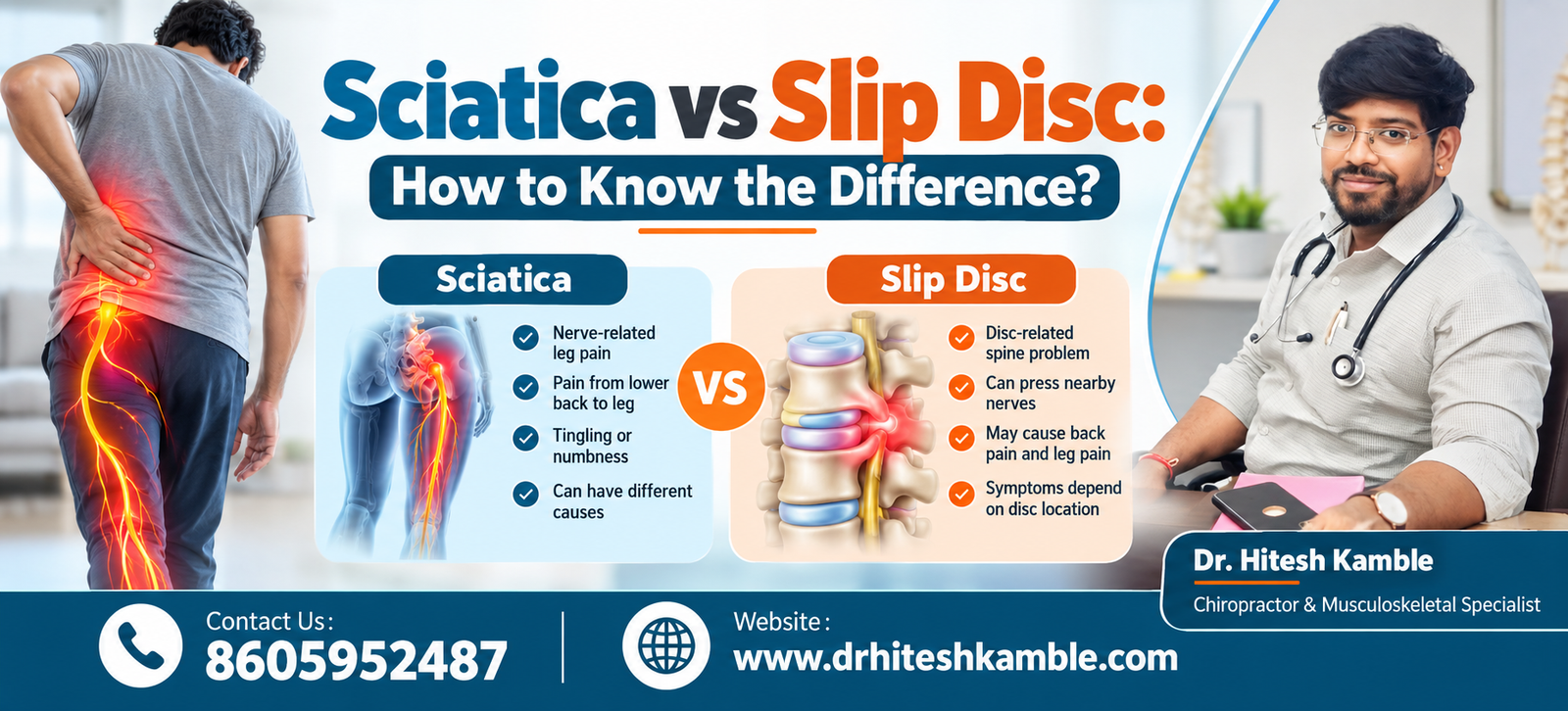
Sciatica vs Slip Disc: How to Know the Difference? – Dr. Hitesh Kamble
Introduction
Back pain that travels into the leg can be confusing because conditions such as sciatica and slip disc can produce similar symptoms. People often use these terms interchangeably, but they do not mean exactly the same thing. A slip disc describes a problem involving an intervertebral disc in the spine, while sciatica refers to symptoms caused by irritation or compression of the sciatic nerve or its nerve roots.
Understanding Sciatica vs Slip Disc can help you recognize why symptoms such as lower back discomfort, leg pain, tingling, numbness, or weakness may occur. Patients experiencing recurring back discomfort, restricted movement, or radiating leg symptoms can also learn more about Chiropractic Care in Ambernath and the assessment-based approach offered by Dr. Hitesh Kamble.
Since several spinal and musculoskeletal conditions can produce similar symptoms, an accurate diagnosis is important before beginning treatment. In this guide, we explain the difference between sciatica and slip disc, their symptoms, possible causes, diagnosis, and available treatment approaches.
What Is Sciatica?
Sciatica describes symptoms that occur when the sciatic nerve or the nerve roots that form it become irritated or compressed. The sciatic nerve is the largest nerve in the body and runs from the lower back through the buttocks and down each leg.
Sciatica commonly affects one side of the body. The discomfort may begin in the lower back or buttock and travel down the thigh, calf, or sometimes into the foot.
Sciatica is therefore a pattern of nerve-related symptoms rather than a specific disease itself. Identifying what is irritating the nerve is an important part of treatment planning.
Common Symptoms of Sciatica
Sciatica commonly causes discomfort that travels from the lower back or buttock down one leg. The sensation may feel sharp, shooting, burning, or electric and can sometimes extend into the foot. Tingling, numbness, or pins-and-needles may also occur along the affected nerve pathway. In some cases, muscle weakness can develop and should be medically evaluated.
What Is a Slip Disc?
The spine contains intervertebral discs between the vertebrae. These discs provide cushioning and help the spine move and absorb mechanical forces.
A slip disc, commonly referred to medically as a herniated or prolapsed disc depending on the specific condition, occurs when disc material extends beyond its usual position. If this material irritates or compresses a nearby spinal nerve root, symptoms can develop.
A disc problem can occur in different areas of the spine, although the lower back is a common location.
Common Symptoms of a Slip Disc
A slip disc may cause lower back discomfort, stiffness, or difficulty with certain movements. If the affected disc irritates a nearby nerve, symptoms may extend into the buttock, thigh, leg, or foot. Tingling, numbness, or muscle weakness can also occur depending on the nerve involved. Symptoms may become more noticeable during bending, lifting, coughing, or prolonged sitting.
Sciatica vs Slip Disc: What Is the Main Difference?
The main difference between Sciatica vs Slip Disc is that they describe different aspects of a spinal problem.
Sciatica refers to a collection of symptoms caused by irritation or compression of the sciatic nerve or its contributing nerve roots. Slip disc refers to a structural change affecting an intervertebral disc.
A slip disc in the lower spine can compress a nerve root and cause sciatica. However, not every person with sciatica has a slipped disc, and not every slipped disc produces sciatic symptoms.
Can a Slip Disc Cause Sciatica?
Yes. A herniated disc in the lower back is one possible cause of sciatica.
When displaced disc material presses against or irritates a nerve root connected to the sciatic nerve, discomfort can travel from the lower back or buttock into the leg.
However, sciatica can also have other causes. This is why symptoms alone cannot always establish whether a slipped disc is responsible.
Other Possible Causes of Sciatica
A herniated or slipped disc is one possible cause of sciatica, but it is not the only one. Sciatic symptoms can also occur due to spinal stenosis, degenerative changes in the spine, spondylolisthesis, or certain spinal injuries. These conditions may irritate or compress nerve roots that contribute to the sciatic nerve. Identifying the underlying cause is important for selecting an appropriate treatment approach.
Why Sciatica and Slip Disc Are Often Confused
Sciatica and a slip disc are commonly confused because both can involve lower back and leg symptoms. A patient with a lumbar disc herniation may experience pain radiating into the leg, tingling, or numbness—the same symptoms commonly described as sciatica.
The key distinction is that sciatica describes the nerve symptoms, whereas a slip disc describes a possible structural cause of those symptoms.
A clinical examination can help identify the likely source rather than relying on symptoms alone.
How Is Sciatica Diagnosed?
Sciatica is generally diagnosed through a detailed medical history and physical examination. The doctor may evaluate where the symptoms travel, muscle strength, sensation, reflexes, spinal movement, and signs of nerve irritation. Imaging such as an MRI is not required for every patient but may be recommended when symptoms are severe or persistent or when significant neurological findings are present. The diagnosis should consider both symptoms and examination findings.
How Is a Slip Disc Diagnosed?
A physical examination is also important when a slipped or herniated disc is suspected. The doctor may assess spinal movement, muscle strength, sensation, reflexes, and signs of nerve irritation.
When imaging is clinically required, an MRI scan can provide detailed information about the spinal discs, nerve roots, and surrounding structures.
Importantly, imaging findings need to be interpreted alongside symptoms and examination findings because disc changes can sometimes be present even in people without significant symptoms.
Sciatica vs Slip Disc: Symptoms Comparison
Although the two conditions overlap, understanding the pattern of symptoms can be useful.
Sciatica typically produces nerve-related symptoms that travel from the lower back or buttock into the leg. Tingling, burning, numbness, or shooting sensations may accompany the discomfort.
A slipped disc may cause localized back symptoms or nerve-related symptoms if the disc irritates a nearby nerve. Therefore, a person with a slipped disc may develop sciatica, while another person with a disc abnormality may experience primarily back symptoms or even no symptoms.
should consider both symptoms and examination findings.
Treatment for Sciatica
Treatment for sciatica depends on its underlying cause, severity, and duration. Conservative management may include appropriate activity modification, physiotherapy, therapeutic exercises, posture and movement guidance, and medication when prescribed by a doctor. Rehabilitation can focus on restoring mobility and gradually improving strength and function. Persistent or worsening neurological symptoms may require further medical or specialist evaluation.
Treatment for a Slip Disc
A slipped disc does not automatically mean that surgery is required. Many patients with disc-related symptoms can initially be managed using non-surgical approaches, depending on their clinical condition.
Treatment may include appropriate activity modification, rehabilitation exercises, physiotherapy, and medicines when prescribed by a doctor.
When significant or progressive neurological problems occur, symptoms remain severe despite appropriate conservative management, or certain complications develop, specialist assessment may be necessary to determine whether additional treatment is required.
Role of Physiotherapy and Rehabilitation
Physiotherapy may be useful for selected patients with sciatica or disc-related symptoms. The rehabilitation programme should be based on the patient’s diagnosis, symptoms, movement limitations, and physical condition.
Treatment may focus on improving mobility, gradually strengthening supporting muscles, correcting movement patterns, and helping the patient safely return to routine activities.
Exercises should be individualized because a movement that is appropriate for one patient may aggravate symptoms in another.
Should You Take Complete Bed Rest?
Prolonged bed rest is generally not considered an ideal approach for uncomplicated lower back or sciatic symptoms. Extended inactivity can contribute to stiffness and loss of muscle conditioning.
Patients may instead be advised to modify activities temporarily and gradually remain active within comfortable limits, depending on their condition.
However, activity recommendations should be individualized, particularly when symptoms are severe or neurological problems are present.
When Should You Seek Medical Evaluation?
Medical evaluation is advisable when back or leg symptoms are persistent, recurrent, worsening, or interfering with everyday activities.
Prompt assessment is particularly important if there is increasing weakness or significant numbness.
Emergency medical evaluation is needed if back or sciatic symptoms occur with new loss of bladder or bowel control, numbness around the groin/saddle region, or rapidly worsening weakness, as these can indicate serious nerve compression.
Can Sciatica or Slip Disc Come Back?Spine Care in Ambernath
Symptoms can recur in some individuals, particularly when underlying spinal changes or contributing mechanical factors remain present.
Maintaining appropriate physical activity, gradually strengthening the muscles supporting the spine, using suitable lifting techniques, and following rehabilitation advice may help manage contributing factors.
No prevention strategy can guarantee that symptoms will never recur, so new or significantly different symptoms should be evaluated appropriately.
Sciatica vs Slip Disc: Why Correct Diagnosis Matters
Because Sciatica vs Slip Disc involves symptoms and structural conditions that can overlap, self-diagnosis based only on where the discomfort occurs can be misleading.
The appropriate treatment depends on identifying whether symptoms are related to a disc problem, another source of nerve irritation, or a different musculoskeletal condition.
A proper clinical assessment helps guide rehabilitation and determines whether additional investigations or specialist evaluation are necessary.
Consultation for Sciatica and Slip Disc in Ambernath
If you are experiencing persistent lower back discomfort, pain travelling into the leg, tingling, numbness, or movement difficulties, an evaluation can help identify the likely cause and appropriate management approach.
Dr. Hitesh Kamble provides assessment and non-surgical management options for patients with musculoskeletal and spine-related complaints in Ambernath.
Treatment recommendations can be planned according to the patient’s symptoms, physical examination, diagnosis, and individual functional requirements.
Get Professional Evaluation for Back and Leg Symptoms
Sciatica and a slipped disc can produce similar symptoms, but they are not the same condition. Sciatica describes nerve-related symptoms, while a slipped disc is one possible structural cause of those symptoms.
If back discomfort is repeatedly travelling into your leg or is accompanied by tingling, numbness, or weakness, obtaining a proper assessment can help determine the cause and guide appropriate treatment.
Dr. Hitesh Kamble
🌐 www.drhiteshkamble.com
Sciatica vs Slip Disc Sciatica vs Slip Disc Sciatica vs Slip Disc Sciatica vs Slip Disc Sciatica vs Slip Disc Sciatica vs Slip Disc Sciatica vs Slip Disc Sciatica vs Slip Disc Sciatica vs Slip Disc Sciatica vs Slip Disc Sciatica vs Slip Disc Sciatica vs Slip Disc Sciatica vs Slip Disc Sciatica vs Slip Disc Sciatica vs Slip Disc Sciatica vs Slip Disc Sciatica vs Slip Disc
