
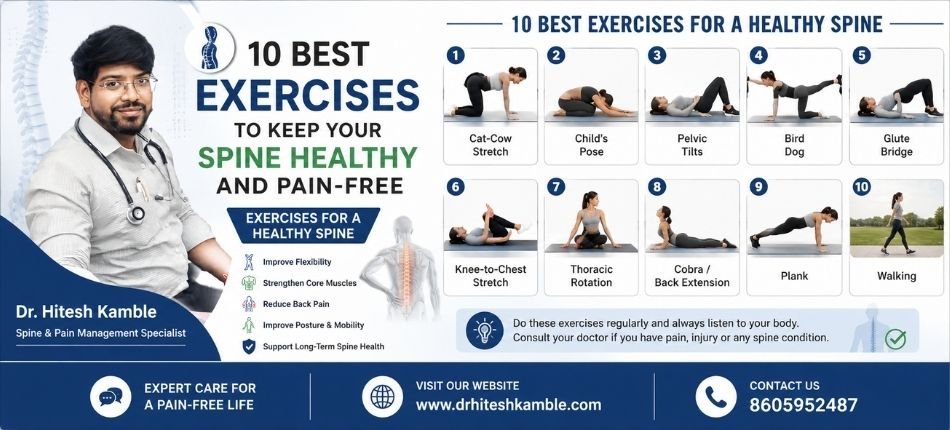
10 Best Exercises to Keep Your Spine Healthy and Pain-Free | Exercises for a Healthy Spine – Dr. Hitesh Kamble
Introduction
Your spine plays an essential role in almost every movement you make—from sitting and standing to walking, bending, lifting, and exercising. However, long hours of sitting, poor posture, lack of physical activity, weak core muscles, and repetitive movements can contribute to stiffness and discomfort.
Regular physical activity can help maintain mobility, flexibility, muscle strength, and better movement patterns. Including appropriate Exercises for a Healthy Spine in your routine may also help support the muscles surrounding your back and reduce unnecessary stress on the spine.
Here are 10 simple exercises commonly used to support spinal mobility, flexibility, and strength. Exercises should always be performed comfortably, and people with an existing injury, persistent pain, numbness, weakness, or a diagnosed spinal condition should seek professional guidance before starting a new exercise program.
Why Is Exercise Important for Spine Health?
The spine is supported by numerous muscles, ligaments, joints, and other structures that work together to provide stability and movement. When the muscles around the spine and core become weak or stiff, everyday activities can place greater stress on the back.
Regular exercise can help improve muscle strength, flexibility, balance, mobility, and posture. A well-rounded routine generally focuses not only on the back itself but also on the abdominal, hip, gluteal, and leg muscles that contribute to efficient movement.
The following Exercises for a Healthy Spine can be incorporated into a general fitness routine when appropriate.
1. Cat-Cow Stretch
The Cat-Cow stretch is a gentle mobility exercise that takes the spine through flexion and extension.
Begin on your hands and knees with your wrists under your shoulders and knees under your hips. Slowly round your back upward while gently lowering your head. Then reverse the movement by allowing your abdomen to move downward while gently lifting your chest.
Move slowly rather than forcing the spine into either position.
Benefits may include:
- Promoting gentle spinal mobility
- Reducing stiffness after prolonged sitting
- Encouraging controlled movement
- Improving awareness of spinal positioning
2. Child’s Pose
Child’s Pose is commonly used as a gentle stretching and relaxation position.
Begin on your hands and knees, move your hips backward toward your heels, and extend your arms forward. Allow your upper body to relax toward the floor while maintaining comfortable breathing.
The position should feel like a gentle stretch rather than pain or pressure.
Benefits may include stretching the lower back and hips while encouraging relaxation of surrounding muscles.
3. Pelvic Tilts
Pelvic tilts are simple exercises that encourage awareness and control of the lower back and pelvis.
Lie on your back with your knees bent and feet resting on the floor. Gently engage your abdominal muscles and tilt your pelvis so that the lower back moves slightly toward the floor. Hold briefly and then relax.
Avoid pressing aggressively into the floor.
Pelvic tilts can be useful for developing basic core control and gentle lumbar movement.
4. Bird Dog
Bird Dog is a popular exercise for developing core stability and coordination.
Start on your hands and knees. Keeping your trunk stable, slowly extend one arm forward while extending the opposite leg backward. Hold briefly before returning to the starting position and repeating on the other side.
The objective is not to lift the arm and leg as high as possible. Instead, focus on maintaining a controlled and stable torso.
This exercise can help strengthen muscles involved in supporting the spine during everyday movements.
5. Glute Bridge
Strong gluteal and hip muscles can contribute to better movement mechanics and reduce unnecessary reliance on the lower back.
Lie on your back with your knees bent and feet approximately hip-width apart. Engage your abdominal and gluteal muscles and gently lift your hips until your body forms a comfortable line from the shoulders toward the knees.
Pause briefly and lower your hips in a controlled manner.
Avoid excessively arching the lower back at the top of the movement.
6. Knee-to-Chest Stretch
The knee-to-chest stretch can provide gentle movement for the lower back and hips.
Lie comfortably on your back and slowly bring one knee toward your chest while keeping the opposite leg relaxed. Hold the position gently and then switch sides.
Some people may prefer bringing both knees toward the chest, but this variation may not be suitable for everyone.
The movement should always remain comfortable.
7. Thoracic Rotation
Many people spend hours working on computers or looking at mobile devices. This can contribute to stiffness through the upper and middle back.
To perform a simple thoracic rotation, begin on your hands and knees or sit upright. Rotate your upper body gently to one side while keeping the movement controlled. Return to the centre and repeat on the other side.
Thoracic mobility exercises can help maintain comfortable rotation through the upper spine.
8. Cobra or Gentle Back Extension
A gentle back extension can encourage movement in the opposite direction to prolonged sitting and forward bending.
Lie on your stomach with your hands positioned near your shoulders. Gently lift your upper chest using a comfortable range while keeping your hips relaxed.
Do not force yourself into a deep extension. People whose symptoms worsen with extension should stop and seek professional guidance.
9. Plank
The plank is widely used for developing core endurance.
Begin on your forearms and toes, or use a modified version with your knees on the floor. Keep your body aligned and gently engage your abdominal muscles without holding your breath.
Instead of attempting a very long hold, beginners can start with short, controlled periods and gradually progress.
A stronger core can help provide support during lifting, bending, walking, and other daily activities.
10. Walking
Walking is sometimes overlooked when discussing Exercises for a Healthy Spine, but regular walking can be an excellent form of general physical activity.
Walking promotes movement throughout the body, engages the lower limbs and trunk, and can help reduce the amount of time spent sitting.
Start with a comfortable duration and gradually increase your walking time according to your fitness level.
How Often Should You Exercise for Spine Health?
There is no single routine suitable for everyone. Exercise frequency and intensity depend on factors such as age, fitness level, lifestyle, existing conditions, previous injuries, and individual goals.
A combination of regular movement, strengthening, flexibility exercises, and aerobic activity can be useful for maintaining general musculoskeletal health.
Most importantly, avoid suddenly performing exercises that are significantly beyond your current ability.
Exercises Alone Are Not Enough: Improve Your Daily Habits
Even the best Exercises for a Healthy Spine should be combined with healthy everyday habits.
Avoid remaining in the same position for excessively long periods. Take regular movement breaks during desk work, use comfortable working positions, lift objects using appropriate technique, remain physically active, and gradually build strength.
Sleep, stress management, overall fitness, and maintaining a healthy lifestyle can also influence musculoskeletal well-being.
When Should You Consult a Professional?
Occasional mild stiffness can occur for many reasons, but persistent or severe symptoms should not simply be managed by trying random exercises.
Seek professional medical evaluation if you experience severe or persistent back or neck pain, pain after significant injury, progressive weakness, numbness, difficulty walking, changes in bladder or bowel control, or other concerning symptoms.
A healthcare professional can evaluate the problem and recommend an appropriate treatment or rehabilitation plan.
Conclusion
A healthy spine depends on regular movement, adequate strength, flexibility, and sensible everyday habits. Exercises such as Cat-Cow, Bird Dog, bridges, pelvic tilts, walking, and appropriate core strengthening can contribute to a balanced fitness routine.
However, Exercises for a Healthy Spine should always be selected according to your individual needs and physical condition. If you are experiencing recurring back or neck discomfort, professional assessment can help determine which movements and exercises are appropriate for you.
Dr. Hitesh Kamble provides professional guidance for spine, posture, and musculoskeletal concerns, helping patients work toward better mobility and long-term physical well-being.
Exercises for a Healthy Spine Exercises for a Healthy Spine Exercises for a Healthy Spine Exercises for a Healthy Spine Exercises for a Healthy Spine Exercises for a Healthy Spine Exercises for a Healthy Spine Exercises for a Healthy Spine Exercises for a Healthy Spine Exercises for a Healthy Spine Exercises for a Healthy Spine
